
defined end vs. open retainer
One has an end. One just continues.
A lot of transformation engagements start with genuine ambition and drift, almost imperceptibly, into an open-ended advisory retainer — regular meetings, ongoing recommendations, steady billing, and no clear point at which anyone could say the transformation actually happened. This isn’t usually anyone’s intention. It’s what happens by default when an engagement has no defined end from the start.
The engagements that actually change a business tend to share one structural trait the drifting ones don’t: a genuine deadline, set at the outset, that the whole programme is built around.
Why open-ended engagements rarely produce transformation
An open retainer optimises for a different thing than transformation does, even when everyone involved genuinely wants the same outcome. Without a deadline, there’s no forcing function that requires decisions to actually be made rather than discussed. Meetings continue, recommendations accumulate, and the relationship itself becomes comfortable enough that neither side feels urgency to conclude anything — because concluding it would end a relationship that’s working fine on its own terms, even if the underlying business hasn’t actually changed.
This isn’t a matter of bad faith on either side. It’s a structural incentive problem. A retainer is paid for presence and ongoing counsel, not for a defined outcome delivered by a specific date. Both the advisor and the business can be entirely satisfied with the relationship — regular useful conversations, thoughtful recommendations — while the actual transformation the engagement was meant to produce sits permanently a few months away from being finished.
What a defined end actually forces
Setting a genuine deadline at the start of an engagement changes the nature of the work in ways that go beyond simply having a date on a calendar.
It forces prioritisation instead of accumulation. With ninety days rather than an open horizon, a programme can’t attempt everything that would theoretically be useful. It has to identify the handful of changes that actually matter most and drive those to completion, rather than generating an ever-growing list of recommendations that never quite gets fully executed.
It forces decisions to be made, not just discussed. An open-ended relationship can revisit the same strategic question in slightly different language every quarter without ever forcing a conclusion. A defined end means a decision has to be reached and acted on by a specific date, because there’s no “next quarter” to push it into.
It creates genuine momentum instead of steady-state comfort. Teams inside the business work differently when they know a programme has a hard end date than when they’re participating in an ongoing advisory relationship with no natural conclusion. Urgency, used well, is a resource — and a deadline is what generates it honestly, rather than manufacturing artificial pressure that everyone can see through.
It creates a genuine point of accountability. At the end of a defined programme, there’s an honest question to answer: did the thing we set out to change actually change? An open retainer never quite reaches that moment, because there’s always more time, which means there’s never quite a reckoning either.
Why ninety days, specifically
The number itself matters less than the principle, but ninety days tends to be the right order of magnitude for a genuinely focused transformation effort, for a specific reason: it’s long enough to actually implement a meaningful change — not just diagnose one — but short enough that it can’t quietly expand to cover everything, which is what happens to longer, less bounded timelines. A programme measured in months forces a specific, achievable scope. A programme measured in an undefined “ongoing” horizon has no natural discipline forcing that same focus.
This doesn’t mean every genuine transformation is complete in ninety days — some initiatives are bigger than a single sprint. What it means is that even a larger transformation is better served by being broken into a sequence of defined, bounded programmes, each with its own clear scope and end date, rather than one continuous open engagement that never quite concludes any single piece of work.
What this means practically
Before a transformation engagement starts, the specific, measurable thing that will be different at the end needs to be named — not a general direction, but a concrete change: this process redesigned and live, this capability built and functioning independently, this metric moved by a defined amount. And the end date needs to be real, not aspirational — a date the programme is actually built around, not a soft target that quietly becomes “let’s continue for another quarter” once it arrives.
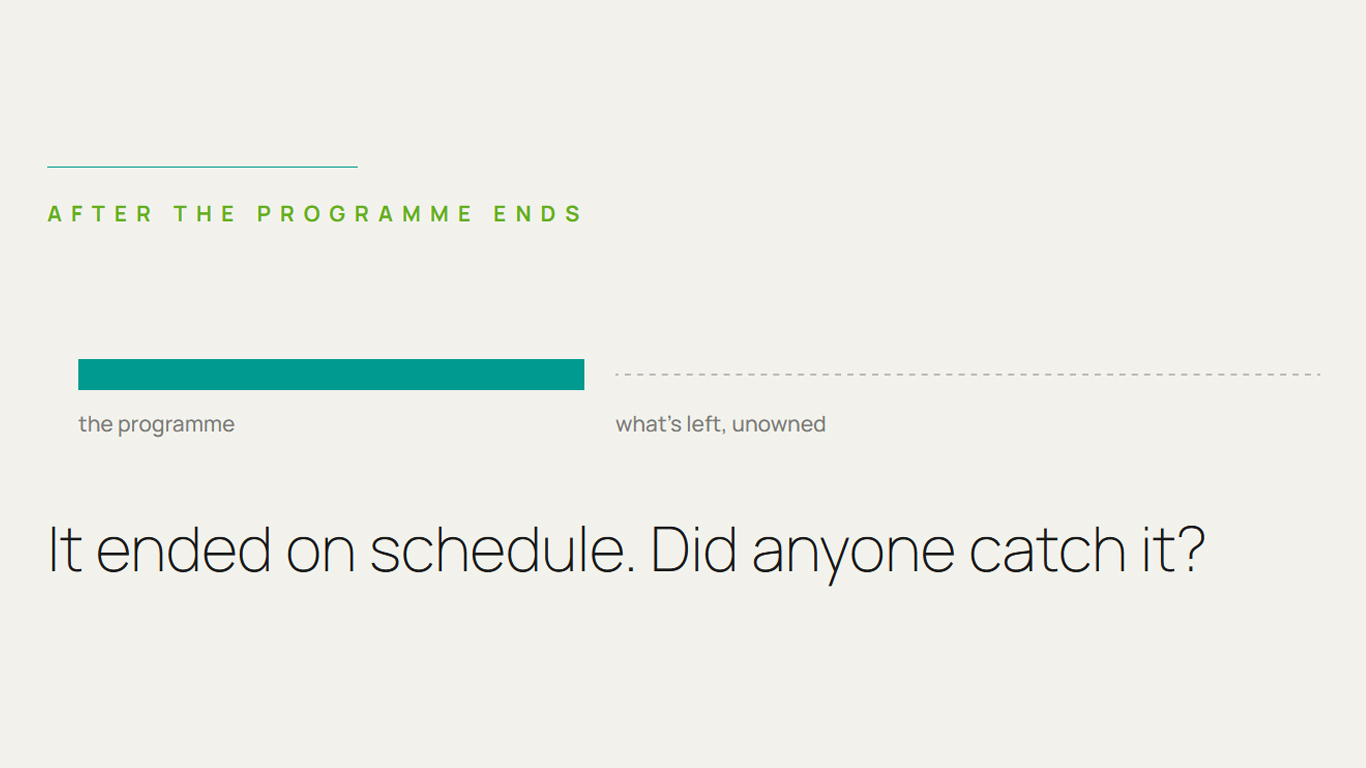
The alternative — comfortable, ongoing, well-intentioned advisory work with no defined conclusion — can go on for years without ever quite producing the transformation it was meant to deliver. Both parties can be satisfied with the relationship the entire time. That satisfaction is exactly why it’s worth being suspicious of it.
If an advisory relationship has been “ongoing” for longer than anyone can remember starting it, it’s probably not delivering transformation anymore — it’s delivering comfort. See how our Transformation Programmes model works →