
outsourced vs. integrated
Beside the business, or part of it.
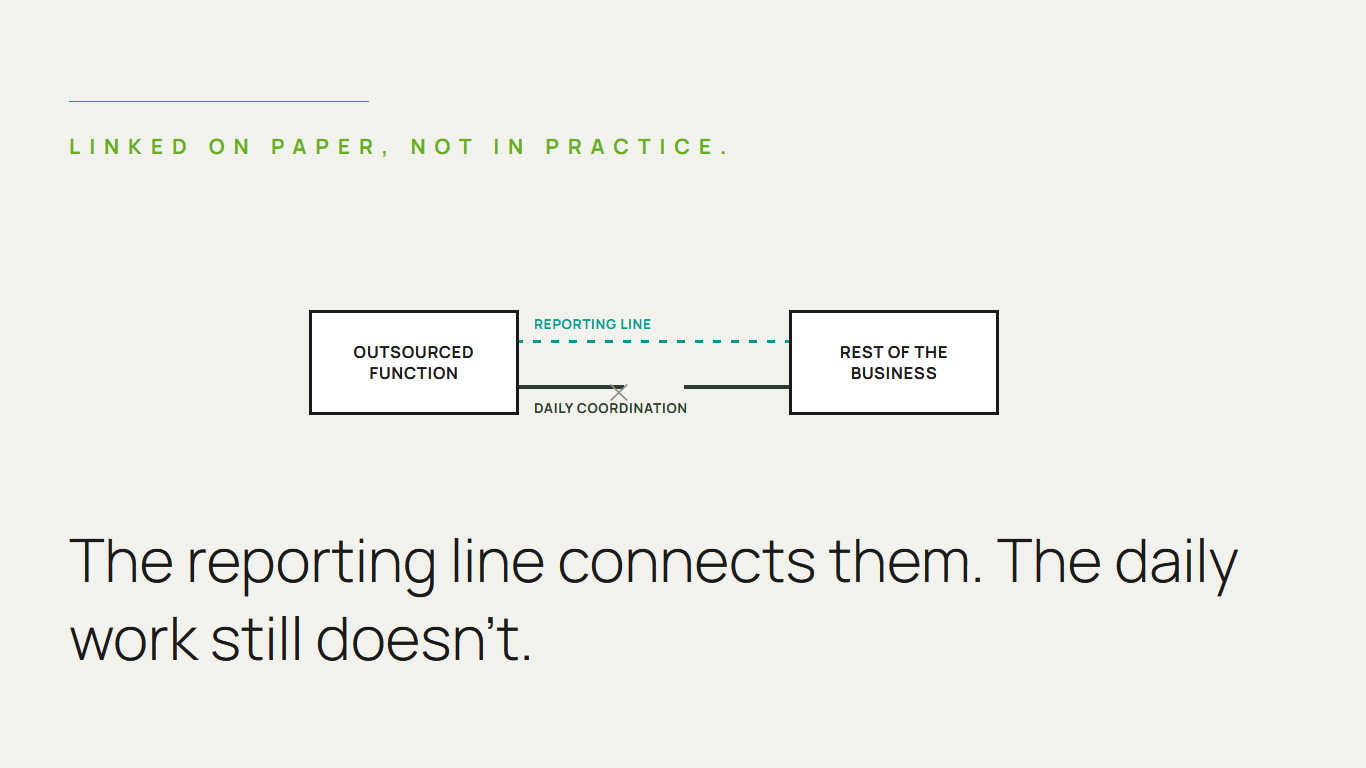
“Outsourced” is a word that covers an enormous range of very different relationships, and mid-market businesses often discover the difference only after signing a contract that didn’t deliver what they expected. On one end sits a vendor who executes defined tasks against a service-level agreement, checks the boxes, and moves on to the next client. On the other sits a team that operates as if it were genuinely part of the business — accountable for outcomes, embedded in decisions, indistinguishable in practice from an internal function. Both get called “outsourcing.” They are not the same thing, and confusing one for the other is how a lot of outsourcing relationships quietly disappoint.
Why the vendor model is the default, even when it isn’t what’s needed
Most businesses default to the vendor model because it’s what “outsourcing” has traditionally meant, and because it’s genuinely the right choice for a lot of work. If you need a defined task executed reliably — payroll processing, a specific campaign, a fixed scope of IT support — a vendor relationship with clear deliverables and a service-level agreement is efficient, low-risk, and appropriately arm’s-length. Nobody needs a vendor to care deeply about the business’s strategic direction. They need the task done well, on time, at an agreed cost.
The problem starts when a business applies that same arm’s-length model to something that actually needs ownership — an entire function like marketing, or customer success, or a piece of finance operations — and then wonders why the results feel transactional rather than integrated. A vendor executing against a scope will, quite reasonably, do exactly what the scope says and nothing more. If the scope was wrong, or the business’s needs shifted, or the situation called for judgement the contract didn’t anticipate, a vendor relationship has no natural mechanism to adapt. That’s not a failure of the vendor. It’s simply what the relationship was built to do.
What genuine ownership actually requires
An integrated function isn’t defined by proximity or by how often the team is in the building. It’s defined by whether the people running it are accountable for outcomes the way an internal team would be, not just for completing defined tasks.
They carry the KRA, not just the deliverable. A vendor is judged on whether the agreed work was completed. An integrated function is judged on whether the underlying business result improved — leads converted, costs reduced, customer retention held. That’s a materially different standard, and it changes how the team operates day to day: they’re not asking “did we do what the contract said,” they’re asking “did the number move.”
They have the authority to adapt without escalating every change. A vendor typically needs a change order to shift scope. An integrated function, because it’s accountable for the outcome rather than a fixed deliverable, has the latitude to adjust its approach as circumstances change — without that adjustment becoming a commercial negotiation every time.
They sit inside the business’s actual decision-making, not outside reporting into it. A vendor delivers a report and waits for direction. An integrated function participates in the conversations that shape direction in the first place — because they’re expected to bring judgement to the table, not just execution.
They’re measured the same way an internal hire would be. If the function’s success is judged purely by SLA compliance — tickets closed, campaigns launched, response times met — it’s still a vendor relationship regardless of what the contract calls it. Genuine integration means being judged on the same commercial outcomes an internal leader would answer for.
Why this distinction matters more than it sounds like it should
Businesses that need an integrated function but buy a vendor relationship tend to experience a specific, recognisable disappointment: competent execution, on schedule, against agreed scope — and results that never quite move the needle the way they’d hoped. It’s not that the vendor did a bad job. It’s that nobody in the relationship was actually accountable for the outcome, only for the activity, and activity without ownership rarely compounds into the results a genuine internal function would produce.
Conversely, businesses that only need a defined task done reliably, but end up paying integration-level pricing for it, are overpaying for accountability they didn’t actually require. Getting this match right — which kind of relationship a given need actually calls for — is worth working out honestly before the engagement starts, not discovering the mismatch six months in.
How to tell which one you actually need
A simple test: if the work has a defined, stable scope and success is fully described by “was it delivered as specified,” a vendor relationship is the right, efficient answer. If success actually depends on judgement, adaptation, and ownership of a business outcome that can’t be fully specified in advance, the function needs to be integrated — treated, structurally and commercially, the way an internal hire would be treated, even if the people doing it sit outside the payroll.
If a function in your business needs someone who thinks like an owner, not just a vendor executing a brief, that’s what integration is built for. See how our Integrated Business Function model works →