
five signals to check
One low bar tells you where to look
An integrated function can look, from the outside, exactly like it’s succeeding — deliverables land on time, meetings happen, the team seems capable and busy. And it can still, underneath that activity, not actually be delivering the thing the model was built to provide: genuine ownership of a business outcome. The distinction between a function that’s executing well and one that’s genuinely integrated isn’t always visible at a glance. It’s worth knowing what to actually check for.
Why “busy and competent” isn’t the same as “working”
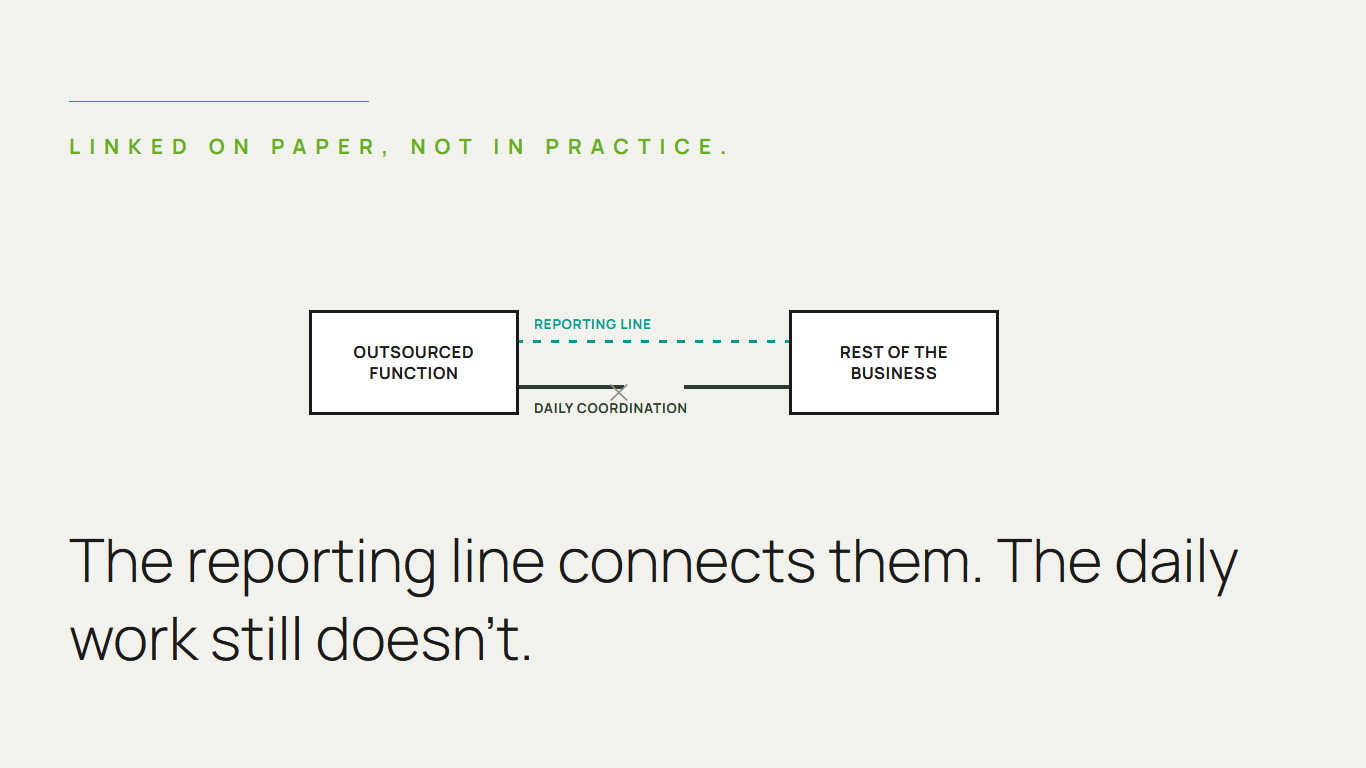
The vendor model this engagement type is meant to replace was never a problem of competence. Plenty of vendor relationships execute flawlessly against their scope. The problem the integrated model exists to solve is accountability for outcomes rather than activity — and that’s precisely the thing that’s hardest to observe from a distance, because activity is visible and accountability isn’t, until something tests it.
A function can hit every deliverable on schedule and still be operating, functionally, as a well-run vendor relationship rather than a genuinely owned one — which means the business hasn’t actually gotten what it set out to buy, even though nothing looks obviously wrong.
Five signals worth checking, honestly
Do they raise problems before you ask, or only answer when asked? A genuinely integrated function surfaces bad news, emerging risks, and uncomfortable observations proactively, the way an internal leader accountable for the outcome would. A function still operating in vendor mode tends to answer what it’s asked and stay quiet about what it wasn’t — which looks like discretion, but is often just a lack of ownership over the result.
Do decisions get made, or do they get escalated for approval? Watch how often the function comes to you with a decision already made and explained, versus a decision it’s waiting on you to make. A high escalation rate for things that should sit within the function’s own judgement is a strong signal the relationship hasn’t actually crossed from executing a brief into owning an outcome.
When results disappoint, whose problem is it? This is often the clearest test available. If a bad quarter produces “here’s what we’re changing to fix it” from the function itself, that’s ownership. If it produces an explanation of why the scope or the brief made the result unavoidable, that’s a vendor relationship, regardless of what the contract calls it.
Does the function’s language sound like an owner’s, or a contractor’s? This is a softer signal, but a real one. Listen for the difference between “we recommend” and “we’re doing” — between language that positions the function as advising the business from outside it, and language that positions it as inside the business, accountable for the same outcome an internal leader would be.
Would losing this function feel like losing a capability, or like needing to find a new vendor? If the honest answer is closer to “we’d need to re-tender the work,” the function was never actually integrated, whatever it was called. A genuinely embedded function, if it ended, would leave behind an actual gap in the business’s operating capability — not just an empty line item to refill.
What to do if the answers aren’t reassuring
Discovering that an “integrated” function is actually operating more like a vendor relationship isn’t necessarily a failure of the people doing the work — it’s often simply a structural drift that happens gradually, without anyone deciding it should. The fix isn’t usually to end the relationship. It’s to name the gap directly and reset the terms of engagement — clarifying that decisions within a defined scope don’t need escalation, that proactive flagging of problems is expected rather than optional, and that the function’s own language and reporting should reflect ownership of the outcome, not just delivery of a brief.
This conversation is uncomfortable precisely because the function has usually been executing competently the entire time — which makes it easy to assume everything is fine. But competent execution and genuine ownership are different things, and only one of them is what an integrated function engagement is actually meant to deliver.
The reframe worth checking against
An integrated function isn’t measured by whether the work got done. It’s measured by whether someone, inside that function, is thinking about the outcome the way an internal leader would — proactively, with judgement, and with genuine accountability when things don’t go to plan. If that’s happening, the model is working exactly as intended. If it isn’t, the function is probably still executing well against a brief, which is a perfectly fine thing to have — it just isn’t what integration was meant to provide.
If an integrated function in your business feels more like a well-run vendor than a genuinely owned capability, that gap is worth naming directly. See how our Integrated Business Function model works →